
For most of this decade, ordering food online in India has meant opening one of two apps. That is about to change.
Flipkart is preparing to launch its own food delivery service, reportedly branded "Eat-in by Minutes". It is piloting in Bengaluru, targeting a public launch by the end of October, and reportedly planning five or six cities by the end of 2026. The headline that has restaurants talking is the price: a reported base commission of about 10%, against the 20–25% restaurants typically pay today.
Eternal (Zomato's parent) and Swiggy shares fell when Flipkart first confirmed its plans in July. The question everyone is asking is simple: is this the moment the duopoly breaks, or another big name about to learn how hard this business is?
Here's my POV:
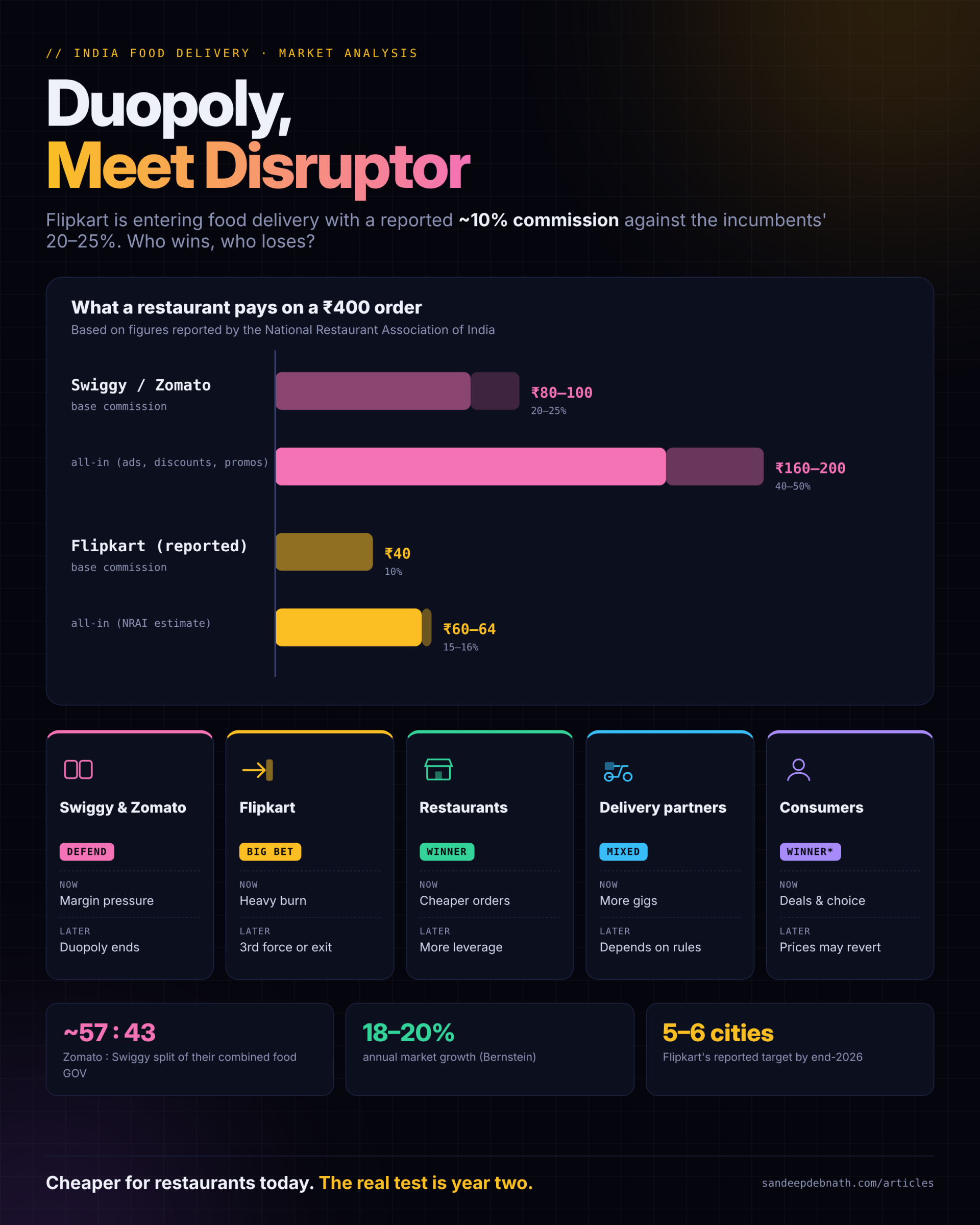
- Restaurants are the clearest short-term winners. On a ₹400 order, reported terms could cut their all-in platform cost from ₹160–200 to around ₹60–64.
- Swiggy and Zomato won't lose their lead quickly, but they will likely face pressure on commissions, discounts and margins. Swiggy looks more exposed than Zomato.
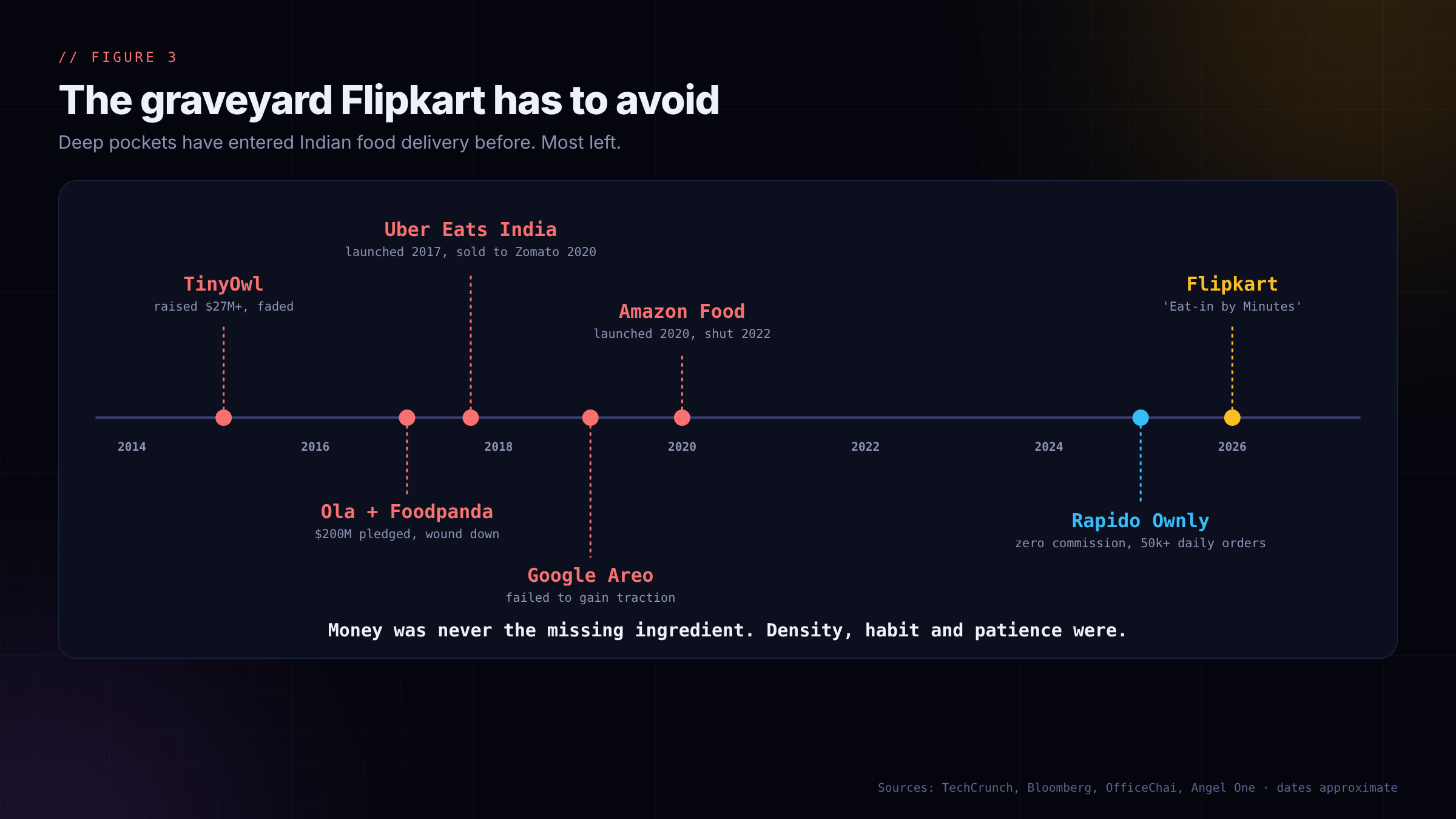
- Flipkart has real advantages in customers, logistics and payments, but the graveyard of failed entrants (Amazon, Uber Eats, Foodpanda, Google Areo) shows money alone isn't enough.
- Delivery partners get more demand, not necessarily better work. The Blinkit "10-minute" episode shows how speed promises turn into safety and labour issues.
- Consumers win in the short run. The bigger long-term benefit is that a third player keeps fees honest.
1. The market Flipkart is walking into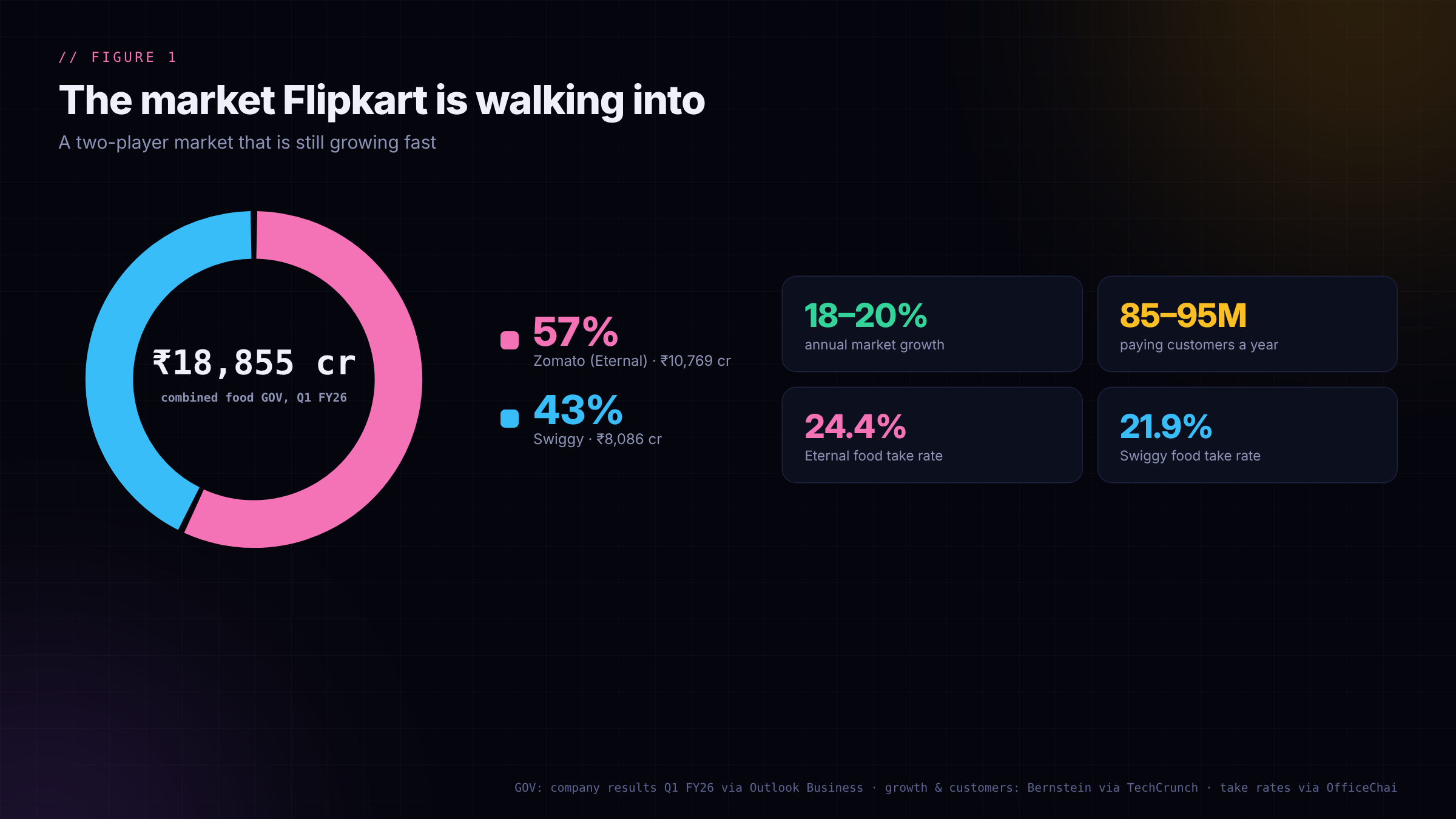
Indian food delivery is a two-player market that is still growing fast:
- In Q1 FY26, Zomato's food delivery gross order value (GOV) was ₹10,769 crore and Swiggy's ₹8,086 crore. That's roughly a 57:43 split between the two.
- Bernstein estimates the market is growing 18–20% a year. The two platforms serve an estimated 85–95 million paying customers annually, in a country with over a billion internet subscriptions.
- Online delivery is still only a little over 15% of India's food-services industry, so there's plenty of room left to grow.
- Take rates are high: about 24.4% for Eternal and 21.9% for Swiggy, compared with about 16% for China's Meituan.
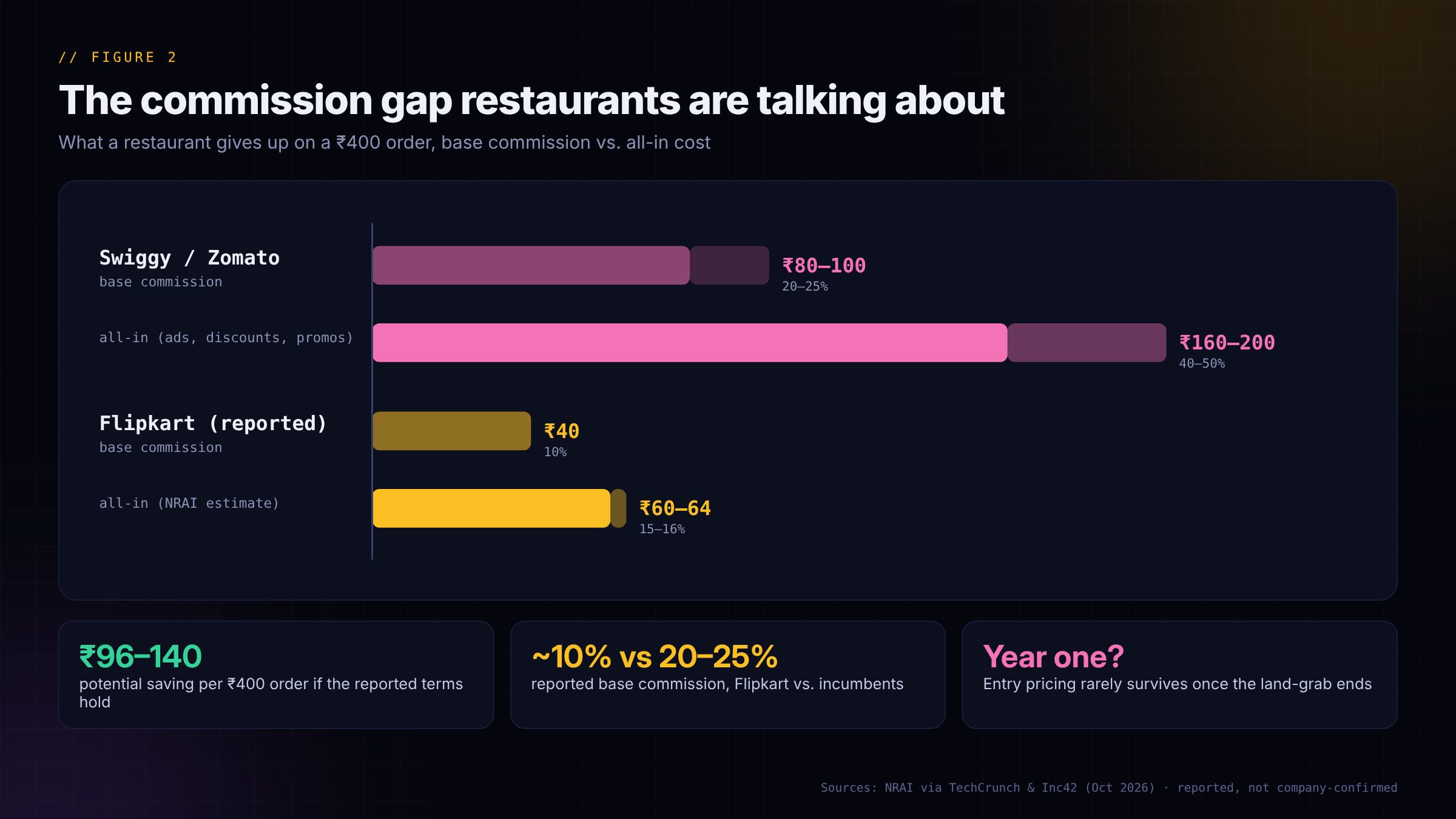
That last number is the opening. When restaurants pay 20–25% in commission, and 40–50% of order value once ads, discounts and promotions are included (per the National Restaurant Association of India), there's a lot of room for someone to undercut.
Researcher's take: a growing market with high take rates and only two suppliers is exactly the kind of market that attracts a well-funded entrant. The question isn't why Flipkart is coming. It's why now and for how long.
2. What Flipkart is bringing
What's been reported so far (company terms aren't officially confirmed):
| Flipkart (reported) | Swiggy / Zomato (typical) | |
|---|---|---|
| Base commission | ~10% | 20–25% |
| All-in restaurant cost | ~15–16% (NRAI estimate) | 40–50% |
| Delivery fleet | Dedicated Ekart rider fleet, separate from quick commerce | Large existing gig fleets |
| Restaurant supply | ONDC plus direct sign-ups | Hundreds of thousands of listed restaurants |
| Where it lives | A tab inside the Flipkart app, next to Minutes | Standalone apps with subscriptions |
| Footprint | Bengaluru pilot, 5–6 cities by end-2026 | National |
The internal pilot reportedly grew from a few hundred employees to more than 8,000.
Flipkart's real advantages
- Distribution without paying for it. Flipkart already has a huge base of shoppers who trust it with payments and addresses. Putting food in a tab inside an app people already use cuts customer acquisition cost sharply.
- Logistics muscle. Ekart and the Flipkart Minutes quick-commerce network give it riders, dispatch technology and hyperlocal experience. NRAI's president expects Flipkart's quick-commerce efficiencies to carry over into food.
- A message restaurants want to hear. "Fair commission" is a powerful story when restaurants openly call the current market a "pathetic" duopoly and competition regulators have previously found issues with incumbent practices.
- Deep pockets. Flipkart Group reported revenue of about ₹1.45 lakh crore in FY26, with losses narrowing. Walmart backing means it can afford a multi-year fight, if it chooses to.
Why it won't be easy
- The graveyard is real. Amazon launched food delivery in Bengaluru in 2020 and shut it in 2022. Uber sold Uber Eats India to Zomato in 2020. Ola pledged $200 million to Foodpanda and later cut 1,500 delivery contracts. Google's Areo never gained traction. Each had money. None built habit.
- Habit and subscriptions. A large share of incumbent orders already come with free delivery through programmes like Swiggy One and Zomato Gold. Customers locked into those don't switch for ₹20–30 off.
- Density is everything. Food delivery only works when there are enough restaurants and riders in every neighbourhood at 1 PM and 8 PM. Building that city by city is slow and expensive.
- Incumbents will respond. Bernstein notes that new entrants might save customers ₹20–30 per order, but the incumbents can simply deepen discounts in return.
- It's not just Flipkart. Rapido's Ownly charges restaurants zero commission and has reportedly crossed 50,000 daily orders. Swiggy has launched the value app Toing. Smaller pilots like Swish Go and MegaBite are testing no-fee models. The low-cost lane is getting crowded.
- The unit economics are tough. With average orders around ₹220–230 in India, a 10% commission leaves very little to pay riders, fund discounts and cover technology. Low commissions have to be funded by something else, such as ads, cross-selling or patience.
- New labour costs. Since November 2025, platforms must contribute 1–2% of turnover towards gig worker social security under the new labour codes. That raises everyone's cost floor.
Analyst's take: Flipkart's advantage isn't the commission rate, which anyone can match for a while. It's that food can ride on top of an existing customer base and logistics network. Whether that's enough depends on one thing: will Flipkart's leadership keep funding food delivery through the next two years, including the IPO period?
3. What it means for Swiggy and Zomato
Both incumbents will feel pressure, but not equally.
- Commission pressure. Restaurants now have a credible alternative to point to in negotiations. Even if Flipkart stays small, its existence lowers the ceiling on what incumbents can charge.
- A discount war. The fastest defence is subsidy: free delivery, coupons, loyalty perks. That protects share but hurts margins at a time when investors want profits.
- Zomato is better placed. It has the larger share and a more established food business. Swiggy looks more exposed: it reported wider losses in recent quarters while also funding Instamart's quick-commerce expansion.
- Their moats still matter. Selection, delivery reliability, ratings and reviews, subscriptions and years of user habit don't disappear because a new tab appears in another app.
Marketer's take: expect incumbents to compete on trust and reliability ("your favourite restaurant, on time, every time") rather than price alone, and to lean on loyalty programmes. Expect Flipkart to compete on fairness and value ("good for restaurants, good for you") and to lean on its sale events and existing loyalty points. Watch also for a quieter fight over restaurant exclusivity and price parity, which competition regulators have looked at before.
4. What it means for restaurants
This is where the impact is most direct.
On a ₹400 order:
- Swiggy/Zomato base commission at 20–25% = ₹80–100
- All-in cost at 40–50% (commission + ads + discounts + promotions) = ₹160–200
- Flipkart all-in estimate at 15–16% = ₹60–64
That's a potential saving of ₹96–140 per order, if the reported terms hold.
The upside for restaurants:
- Better margins on every Flipkart order.
- More bargaining power with the incumbents.
- A chance to price lower on Flipkart and reach new customers.
The catches:
- Volume matters more than rate. A 10% commission on 20 orders a day is worth less than 22% on 200. Most restaurants will multi-home, not switch.
- More operational load. Another tablet, another menu, another set of ratings, another payout cycle.
- Launch terms rarely last. History says entry pricing gets revised once a platform has scale. Restaurants should enjoy the discount but plan as if it's temporary.
- Discount pressure doesn't disappear. If platforms fight with offers, restaurants are often asked to co-fund them.
Advice to restaurant owners: join early while terms are best, push for transparent commission and ad pricing in writing, and track profit per order on each platform, not just order counts.
5. What it means for delivery partners and employment
More platforms competing usually means more demand for riders, at least in the short term. Flipkart is reportedly building a dedicated Ekart fleet, which means hiring and joining incentives in launch cities.
But employment numbers are only half the story. The other half is the quality of that work, and India has just had a very public lesson in that.
The Blinkit lesson
Early in 2026, Blinkit dropped its "10-minute delivery" promise, followed by Zepto. That came after a nationwide gig worker strike on New Year's Eve, public outrage over a delivery executive's death in a road accident in Hyderabad, and a meeting called by the Labour Ministry with major platforms on worker safety. Earlier, in 2025, Blinkit delivery staff had alleged their IDs were blocked after a strike.
The lesson for every new entrant: speed promises made to customers become pressure carried by riders. Flipkart's own branding ("Eat-in by Minutes") will invite exactly that scrutiny.
What to watch on employment
- Incentives vs. income. Launch incentives inflate early earnings. What matters is pay per order and per hour once incentives fall.
- Fleet model. A "dedicated" fleet could mean better training and safety, or simply more exclusivity rules. The details matter.
- What happens if the entrant exits. When Ola wound down Foodpanda, it cut 1,500 delivery contracts. A third player that retreats after two years leaves workers worse off than one that never came.
- The new social security rules. Platforms now contribute 1–2% of turnover (capped at 5% of payouts to workers) towards gig worker welfare. How Flipkart treats this, as a cost to minimise or a trust signal, will shape its reputation.
My view: the employment boost is real but fragile. The platforms that win long-term will be the ones riders choose to work for, and that will be decided by earnings transparency, realistic delivery times and how disputes and ID blocks are handled.
6. What it means for consumers
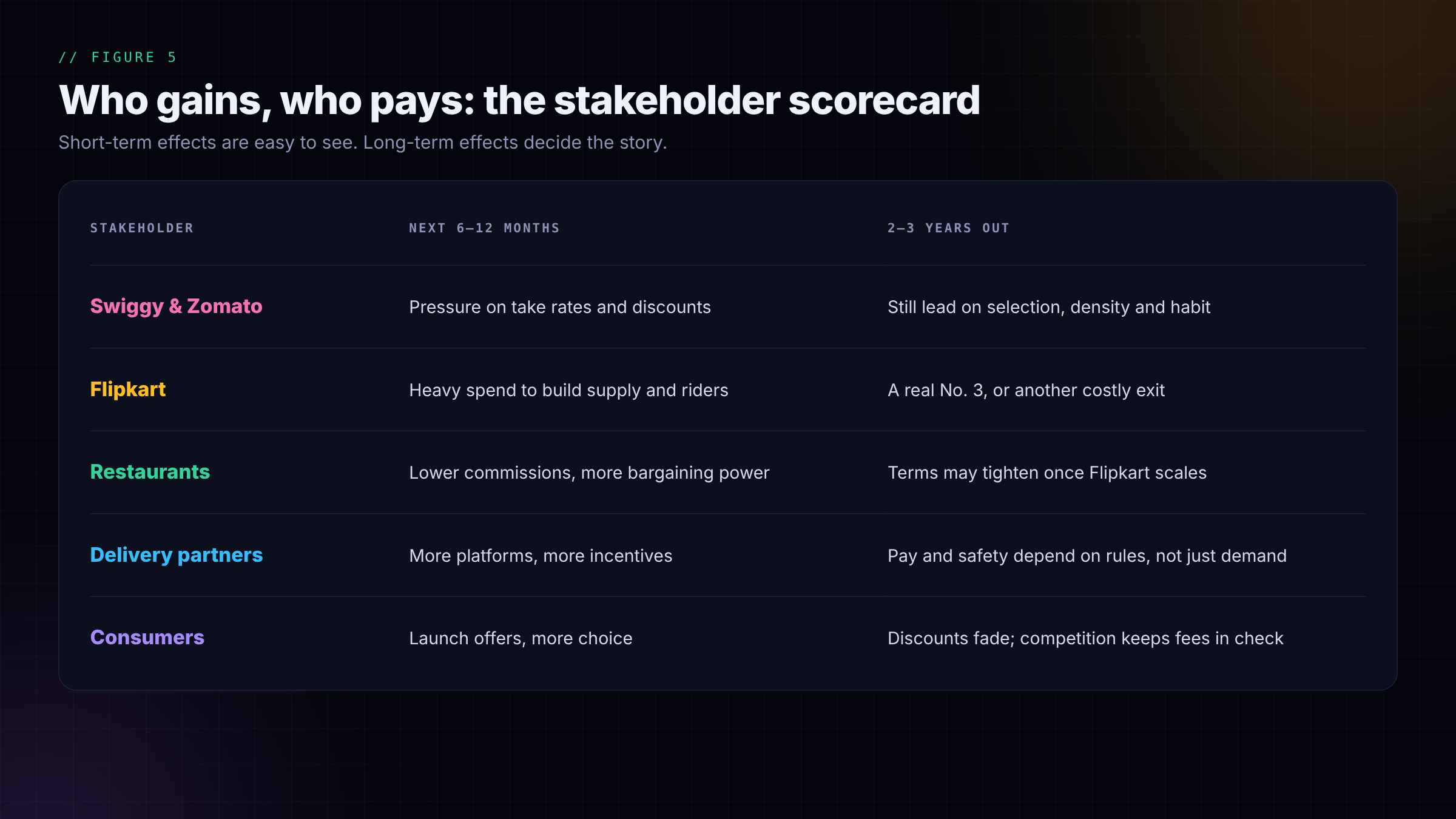
Short term: good news. Expect launch offers, lower prices on some restaurants (if they pass on commission savings) and more choice. Bernstein estimates efficiency savings of ₹20–30 per order are possible.
Medium term: mixed. Launch discounts fade. Service in new cities may be patchy while rider and restaurant density builds. And another app means another loyalty programme to juggle.
Long term: the real benefit. The biggest consumer win isn't a coupon. It's that a credible third player makes it harder for anyone to keep raising platform fees, packaging charges and surge fees. Competition is the cheapest form of consumer protection.
That's why I've marked consumers as "winners" with an asterisk: they benefit most if Flipkart stays in the market, not just if it launches.
7. Three scenarios for the next 24 months
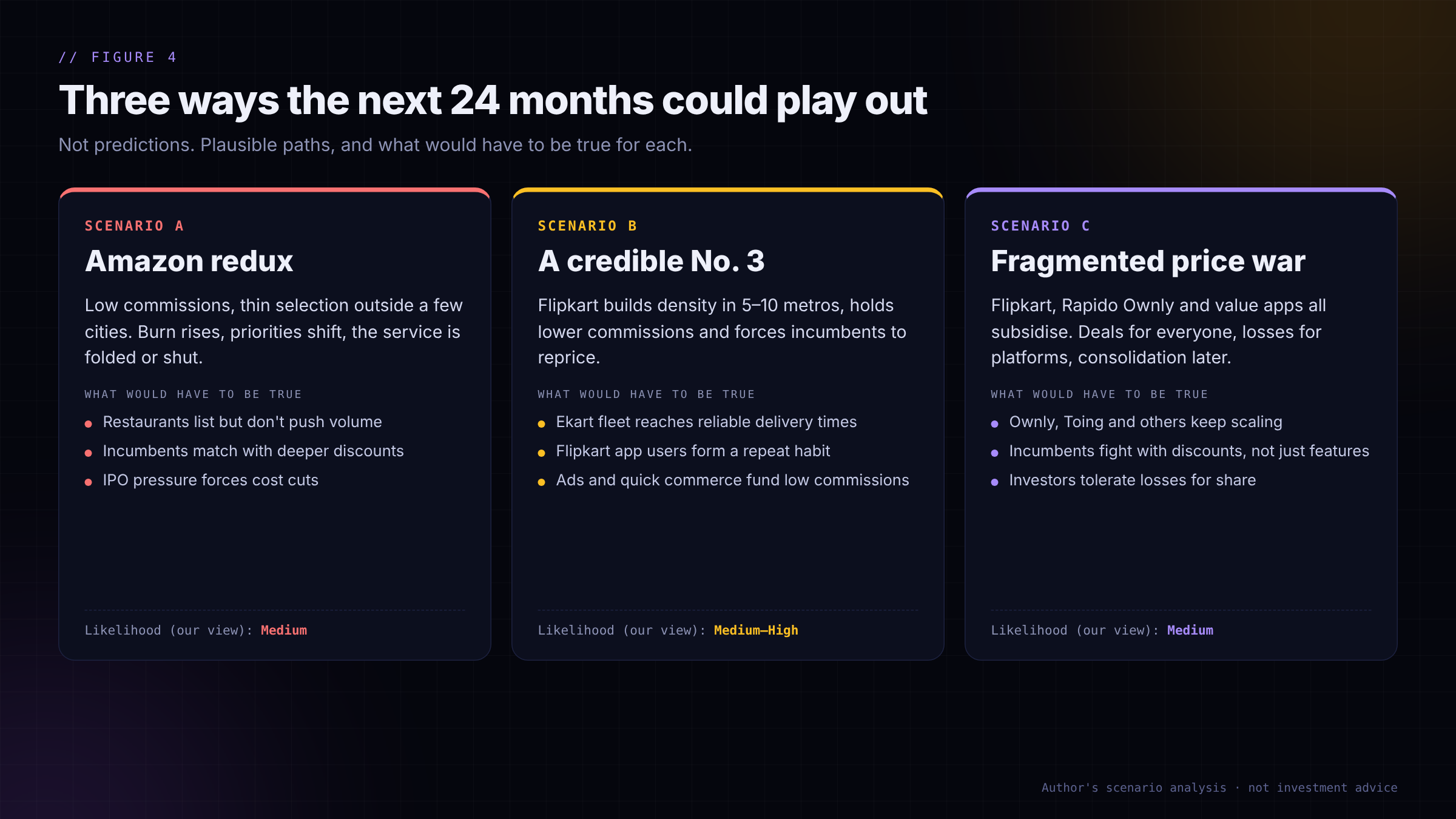
Scenario A: Amazon redux (likelihood: medium). Restaurants list but don't push volume, incumbents match with deeper discounts, and IPO pressure forces cost cuts. Food is folded into quick commerce or quietly shut.
Scenario B: A credible No. 3 (likelihood: medium–high). Flipkart builds real density in 5–10 metros, its app users form a repeat habit, and ads plus quick-commerce synergies fund lower commissions. Incumbents are forced to reprice for restaurants and soften fees for users.
Scenario C: A fragmented price war (likelihood: medium). Flipkart, Rapido Ownly, Swiggy's Toing and others all subsidise at once. Consumers and restaurants enjoy a deal-filled year or two, platforms bleed, and consolidation follows.
These are my judgments, not predictions, and certainly not investment advice.
8. What to watch in the next six months
If you want to know which scenario is unfolding, track these signals:
- City expansion pace: does Flipkart hit five or six cities by end-2026 as reported?
- Commission stickiness: does the ~10% hold after launch, or do "promotional" fees appear?
- Restaurant depth: are popular local favourites live, or mostly ONDC long-tail listings?
- Delivery times and reliability at peak hours, especially in rain.
- Incumbent response: price cuts, restaurant commission changes, or new value apps.
- Rider sentiment: earnings, incentives, and how disputes are handled.
- Flipkart's IPO narrative: is food positioned as a growth engine or a cost line?
The bottom line
Flipkart's entry won't end Swiggy and Zomato's dominance overnight. Their selection, reliability and habit are real moats, and the history of failed entrants is long.
But this entry is different from most. It comes with a ready-made customer base, a logistics network and a restaurant-friendly pricing story at a time when restaurants are openly unhappy with the duopoly. Even if Flipkart ends up as a small No. 3, the rules of the market are likely to shift: lower commissions, more pressure on fees, and more scrutiny on how riders are treated.
The winners in year one are easy to spot: restaurants and consumers. Year two is the real test. That's when the launch offers end and we find out whether Flipkart is here to build a business or just to make a point.


